Qualities of Food & "Like Increases Like"
Every food carries qualities — heavy or light, hot or cold, oily or dry, smooth or rough. Ayurveda's simplest law is that like increases like: a cold, dry, windy constitution gets colder and drier on cold, dry food, and settles on its opposites.
Reading a food's qualities
Cheese is heavy, oily, and cooling. Crackers are light, dry, and rough. Chilli is hot, sharp, and penetrating. You already sense these qualities — Ayurveda just asks you to take them seriously as the way food talks to your body.
Opposites as medicine
Balance comes from the opposite quality: warmth for cold, moisture for dryness, lightness for heaviness. This is why the same soup can be ideal for one person and dulling for another — the question is never only "is it healthy?" but "is it opposite to my excess?"
Preparation changes everything
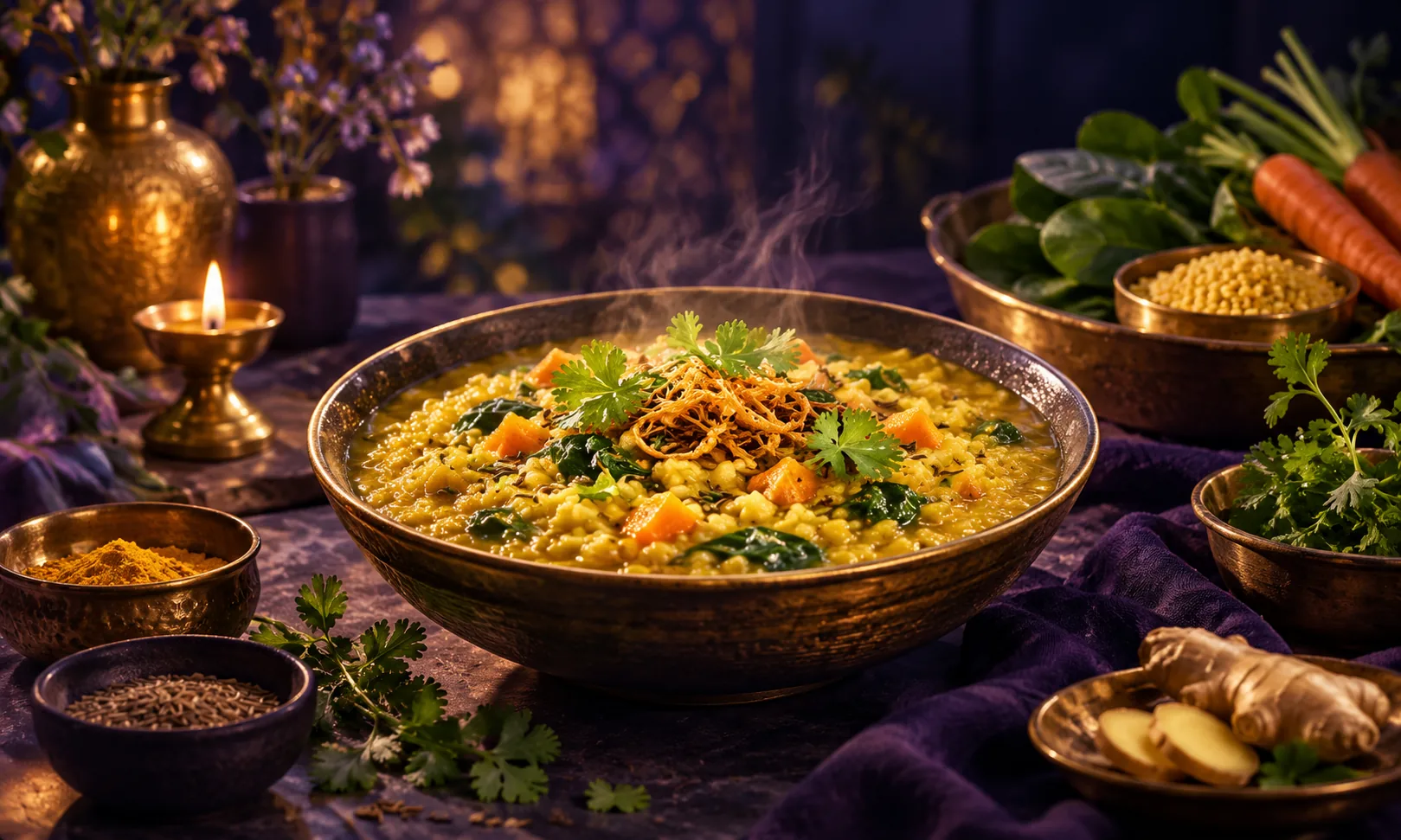
Cooking, spicing, and oiling transform qualities. A raw carrot is rough and cold; the same carrot simmered in gheed spices becomes warm, smooth, and grounding. Preparation is how one ingredient serves three doshas.
Examples
- warm milk with ginger vs. iced milk
- stewed apples vs. raw apple
- dry-roasted chickpeas vs. hummus with oil
By dosha
Vata. Your excess is cold, dry, light, and mobile — favor warm, moist, oily, grounding food and regular rhythm.
Pitta. Your excess is hot, sharp, and oily — favor cooling, mild, slightly dry preparations and moderate portions.
Kapha. Your excess is heavy, cold, damp, and static — favor light, warm, dry, well-spiced food and genuine hunger before eating.
Educational Ayurvedic principles, not medical advice.